coffee filter

There are various ways to brew filter coffee. One of these is to manually pour over a coffee filter made of porcelain, plastic, glass, or stainless steel. This gives you more control over the extraction compared to a filter coffee machine. We'll explain the different types of coffee filters and how they differ.

Price

Coffee filters from Süssmund Kaffee

Kaffeefilter kaufen von Hario bei Süssmund

Why you should brew filter coffee by hand

Brewing filter coffee with a hand filter offers several advantages over brewing coffee with a filter coffee machine. Conventional filter coffee machines often don't distribute the water evenly, but rather only in the center of the dry coffee bed. Furthermore, the water flow rate can be too fast at the beginning and too slow towards the end. Ground coffee collects at the top of the coffee filter and is only extracted insufficiently.

In contrast, using a coffee filter for hand brewing gives you significantly more control over the extraction of your filter coffee. You can adjust the flow rate, the precise distribution of the water stream, and the agitation of the coffee particles in the water at any time. This allows you to replicate recipes much more accurately and thus get the best flavor from the coffee beans. Experimenting is worthwhile!

Brewing Filter Coffee Like a Champion

Brewing Filter Coffee Like a Champion

Yes, they do exist, both nationally and internationally: filter coffee championships, also known as the Brewers Cup. This popular competition crowns the World Brewers Cup Champion annually, for which only one participant per country qualifies in countless tournaments around the globe.

For example, the company history of Süssmund Kaffee began when Nikolaus twice won the Brewers Cup in Austria with his self-roasted coffee, thus laying the foundation for his own coffee roastery.

At the World Brewers Cup 2014 in Rimini, Nikolaus opted for a recipe using the Kalita Wave, a coffee filter with a flat bed and ribbed paper filter.

Here's the recipe to brew at home:

20g coffee (coarse grind)
We recommend a light filter roast
92°C water 300 ml (60 ppm, PH 6.6)

45 sec blooming (50ml)
0:45 pour 70ml
1:30 pour 60ml
2:15 pour 60ml
3:00 pour 60ml
3:30 extraction finished

Frequently Asked Questions

How do you filter coffee properly?

Generally, up to 30% of soluble substances can be extracted from a coffee bean. However, for optimal extraction and thus the best flavor, only 18-22% should be extracted. This can usually be achieved with a hand-brewed filter coffee extraction time of 2-3 minutes. This requires the correct grind size, the water to coffee ratio (brewing ratio), and a suitable pouring technique. You can find detailed preparation instructions for hand-brewed filter coffee in our Brew Guides.

Why use porcelain coffee filters?

Coffee filters are available in many different designs and materials. The decisive factor for a good coffee filter is the material's heat conduction. After all, the coffee filter shouldn't cool the hot water too much. The heat conduction of plastic is actually better than that of ceramic, but there are reservations about plastics, even BPA-free ones. This is why porcelain coffee filters are extremely popular, especially due to the wide variety of colors available.

What difference does the shape of a coffee filter make?

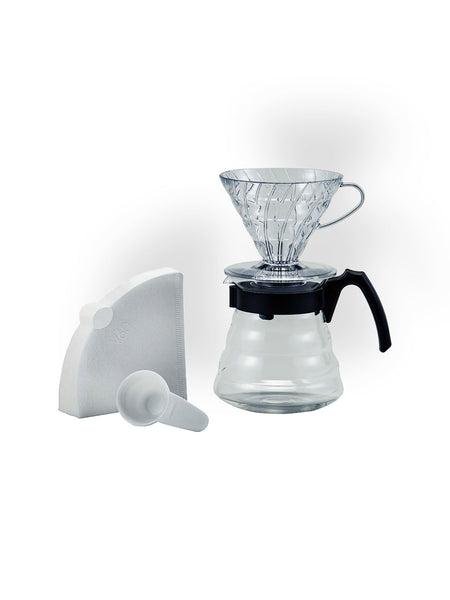
Most coffee filters are conical and have grooves inside that allow the water to drain to the hole at the bottom. One example is the Hario V60. The paper filter is molded to the coffee filter and rests against the material. Hario's V60 hand filter can be considered the standard for filter coffee brewing. However, fines (very fine coffee particles) can collect at the bottom of the paper filter, slowing down the extraction process. For example, a blunt grinder in your coffee grinder produces a particularly high number of fines.

That's why there are also coffee filters that have a flat bottom rather than a tapered one. One example is the popular Kalita Wave. This coffee filter holder uses accordion-shaped paper filters, which create a gap between the filter holder and the grounds. The flat bottom reduces the risk of fines clogging the outlet. This is intended to facilitate even extraction of the coffee particles.